


![[Marketing] Questao Topo - deslogado](https://storage.estuda.com.br/banners/0_6b7ebee90b03af1c560c73bb8bcce34a_banner_deslogado_70_dias.png)
Questões de EFAF Geografia
8.144 Questões
Questão 4 10251463
EFOMM 1º Dia 2020Text
Based on the text below, answer question.
Are shipping containers the future of affordable housing?
Millions of people need homes. Millions of shipping containers are going unused. Could this be an answer to the global housing crisis? Cleveland Containers explore further.
England is facing a housing crisis. According to housing charity Shelter, more than 50,000 households a year are being forced out of their homes, and there are more than 9 million renters in unsecure rented accommodations.
The situation is shaky even for those who own their own homes. 28,900 homes were repossessed across the UK in 2013.
But this situation isn't unique to England. House prices are soaring across the world, which is placing home ownership out of reach for millions. And that's just in the developed world. Around 850 million people are currently living in “informal settlements”. In numerous rapidly urbanising cities, the average housing costs can be up to 200% of the net monthly income.
There is no single explanation as to why the world's facing a housing crisis, and there's no easy answer for how to solve it. But one major factor is a general dearth of good quality, affordable housing. Many developments in the housing market are focused on constructing high-end units that are expensive to build and out of the price range of most. This needs to change.
Desperate times often call for radical Solutions. One thing the world isn't lacking is shipping containers. There may be up to 40 million shipping containers in the world right now, and experts believe that only six million are currently in use.
Who'd live in a shipping Container?
Shipping containers are built to be strong, secure and practical. These are all sound benefits for storage and mass transit, but do they make for comfortable accommodation?
The idea of living in a shipping Container might strike some as odd, unfeasible, impractical and maybe even a little unappealing. But it's important to think of shipping containers not as finished products, but as raw materiais - as exoskeletons for future homes.
Because, really, there's no end to what you can do with a shipping Container. They can easily be insulated and fitted with Windows, doors, indoor partitions, electricity and running water - everything that's needed for human inhabitation. A single shipping Container can be transformed into a cosy dwelling in no time at all. But if more space is needed, you can just stack multiple containers on top of each other.
And if you're really wondering whether people would be comfortable living in converted shipping containers, just consider the great reaction that greets shipping containers converted for retail use. They're thought of as cool, hip and quirky. When used as affordable housing, it's no stretch to say that many won't think of shipping containers as a last resort, so much as actively desirable.
(Abridged and adapted from https://www.openaccessgovemment.org)
According to the text, shipping containers
Questão 3 10251455
EFOMM 1º Dia 2020Text
Based on the text below, answer question.
Are shipping containers the future of affordable housing?
Millions of people need homes. Millions of shipping containers are going unused. Could this be an answer to the global housing crisis? Cleveland Containers explore further.
England is facing a housing crisis. According to housing charity Shelter, more than 50,000 households a year are being forced out of their homes, and there are more than 9 million renters in unsecure rented accommodations.
The situation is shaky even for those who own their own homes. 28,900 homes were repossessed across the UK in 2013.
But this situation isn't unique to England. House prices are soaring across the world, which is placing home ownership out of reach for millions. And that's just in the developed world. Around 850 million people are currently living in “informal settlements”. In numerous rapidly urbanising cities, the average housing costs can be up to 200% of the net monthly income.
There is no single explanation as to why the world's facing a housing crisis, and there's no easy answer for how to solve it. But one major factor is a general dearth of good quality, affordable housing. Many developments in the housing market are focused on constructing high-end units that are expensive to build and out of the price range of most. This needs to change.
Desperate times often call for radical Solutions. One thing the world isn't lacking is shipping containers. There may be up to 40 million shipping containers in the world right now, and experts believe that only six million are currently in use.
Who'd live in a shipping Container?
Shipping containers are built to be strong, secure and practical. These are all sound benefits for storage and mass transit, but do they make for comfortable accommodation?
The idea of living in a shipping Container might strike some as odd, unfeasible, impractical and maybe even a little unappealing. But it's important to think of shipping containers not as finished products, but as raw materiais - as exoskeletons for future homes.
Because, really, there's no end to what you can do with a shipping Container. They can easily be insulated and fitted with Windows, doors, indoor partitions, electricity and running water - everything that's needed for human inhabitation. A single shipping Container can be transformed into a cosy dwelling in no time at all. But if more space is needed, you can just stack multiple containers on top of each other.
And if you're really wondering whether people would be comfortable living in converted shipping containers, just consider the great reaction that greets shipping containers converted for retail use. They're thought of as cool, hip and quirky. When used as affordable housing, it's no stretch to say that many won't think of shipping containers as a last resort, so much as actively desirable.
(Abridged and adapted from https://www.openaccessgovemment.org)
In the excerpt “But one major factor is a general dearth of good quality, affordable housing.”, the word in bold means:
Questão 2 10251436
EFOMM 1º Dia 2020Text
Based on the text below, answer question.
Are shipping containers the future of affordable housing?
Millions of people need homes. Millions of shipping containers are going unused. Could this be an answer to the global housing crisis? Cleveland Containers explore further.
England is facing a housing crisis. According to housing charity Shelter, more than 50,000 households a year are being forced out of their homes, and there are more than 9 million renters in unsecure rented accommodations.
The situation is shaky even for those who own their own homes. 28,900 homes were repossessed across the UK in 2013.
But this situation isn't unique to England. House prices are soaring across the world, which is placing home ownership out of reach for millions. And that's just in the developed world. Around 850 million people are currently living in “informal settlements”. In numerous rapidly urbanising cities, the average housing costs can be up to 200% of the net monthly income.
There is no single explanation as to why the world's facing a housing crisis, and there's no easy answer for how to solve it. But one major factor is a general dearth of good quality, affordable housing. Many developments in the housing market are focused on constructing high-end units that are expensive to build and out of the price range of most. This needs to change.
Desperate times often call for radical Solutions. One thing the world isn't lacking is shipping containers. There may be up to 40 million shipping containers in the world right now, and experts believe that only six million are currently in use.
Who'd live in a shipping Container?
Shipping containers are built to be strong, secure and practical. These are all sound benefits for storage and mass transit, but do they make for comfortable accommodation?
The idea of living in a shipping Container might strike some as odd, unfeasible, impractical and maybe even a little unappealing. But it's important to think of shipping containers not as finished products, but as raw materiais - as exoskeletons for future homes.
Because, really, there's no end to what you can do with a shipping Container. They can easily be insulated and fitted with Windows, doors, indoor partitions, electricity and running water - everything that's needed for human inhabitation. A single shipping Container can be transformed into a cosy dwelling in no time at all. But if more space is needed, you can just stack multiple containers on top of each other.
And if you're really wondering whether people would be comfortable living in converted shipping containers, just consider the great reaction that greets shipping containers converted for retail use. They're thought of as cool, hip and quirky. When used as affordable housing, it's no stretch to say that many won't think of shipping containers as a last resort, so much as actively desirable.
(Abridged and adapted from https://www.openaccessgovemment.org)
Read the statements about the text and decide whether they are TRUE (T) or FALSE (F).
Mark the correct option.
I - There is a surfeit of dwellings in England.
II - Housing is wobbly in England.
III - House prices are steep worldwide.
IV - Home ownership is attainable for many people.
V - Living in a shipping Container is alluring and ordinary throughout the world.
Questão 14 10240521
OBR 1° Ano - Nível 3 2020A NASA anunciou o uso de três aeronaves não tripuladas chamadas Global Hawks, capazes de permanecer em voo por mais de 30 horas, atingir altitudes superiores a 19 quilômetros e recolher dados atmosféricos e climáticos.
Segundo a revista Technology Review, os aviões são completamente autônomos, ou seja, os cientistas podem programar suas rotas antes do lançamento. Eles carregam mais de 10 instrumentos científicos, capazes de mapear os gases e as nuvens na atmosfera e coletar dados meteorológicos como temperatura, ventos e pressão.
(Texto adaptado de http://revistagalileu.globo.com/Revista/Common/0,,EMI130145-17778,00-NASA+USA+AVIAOROBO+PARA+MAPEAR+ATMOSFERA.html)

Um avião autônomo foi utilizado para obter informações meteorológicas em diversas capitais brasileiras. As leituras foram feitas utilizando um conjunto de sensores infravermelhos que medem a temperatura próxima ao solo. O voo foi realizado entre as cidades de Natal-RN e Porto Alegre-RS passando pelas capitais dos estados que possuem litoral sem que fossem feitos desvios ou retornos. A partir dos dados coletados, foi montado o gráfico ao lado que mostra a temperatura obtida nas capitais.
Temperatura em cada capital
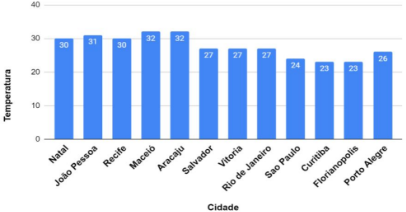
Com base nos dados coletados, qual foi a maior variação de temperatura medida entre as capitais de estados vizinhos?
Questão 12 10240489
OBR 1° Ano - Nível 3 2020Um sistema robótico foi desenvolvido para auxiliar no estudo dos ecossistemas brasileiros. Enquanto um robô permanece na sala de aula fazendo a interação com os estudantes, outros robôs sobrevoam áreas para coletar informações que serão utilizadas pelos alunos para responder às atividades. Em um dos dias de operação, alguns robôs apresentaram um mau funcionamento dos seus sensores causado por uma atualização incorreta do seu programa. Após uma estudante perguntar ao robô da sua sala informações sobre os biomas brasileiros, este forneceu as seguintes respostas:
● Drone 1 informou que seus sensores de GPS e imagem apresentaram que a Caatinga está presente no nordeste brasileiro e possui uma vegetação adaptada à seca;
● Veículo de Terra 2 informou que seu odômetro estimou que a Amazônia é o maior ecossistema brasileiro e abrange aproximadamente 50% do território nacional;
● Drone 3 informou que seus sensores de GPS, altitude e umidade detectaram que a Mata Atlântica localiza-se no Centro-Oeste do Brasil e é a maior planície inundável do mundo;
● Veículo de Terra 4 detectou em seu odômetro que a área do bioma Pampa representa 10% do território nacional e devido a alta umidade detectada por seu sensor, é uma região que contém grandes áreas alagadas.
Sobre quais dos ecossistemas os sensores dos robôs forneceram informações corretas?
Questão 10190862
LICEU-SP LICEU-SP 2020 GERAIS 2020Observe o mapa.

(Ab’Sáber, 2003)
O Domínio Morfoclimático indicado pelo número representa a manifestação zonal das Caatingas, que tem como característica:
06