


![[Marketing] Questao Topo - deslogado](https://storage.estuda.com.br/banners/0_6b7ebee90b03af1c560c73bb8bcce34a_banner_deslogado_70_dias.png)
Questões de EFAF Geografia
8.144 Questões
Questão 11 10771074
EPCAR 2023Direction: Read the text below and answer question.
TEXT
How climate change has altered Christmas
By Isabelle Gerretsen, 2021
While Hollywood's representation of a white Christmas
might be the northern hemisphere ideal, for many around the
world the holiday is celebrated in very different weather. But,
climate change is threatening both winter wonderlands and
[5] warmer Christmas traditions.
In the Netherlands, where I grew up, a popular tradition
around Christmas is to put on your skates and take to the
frozen rivers. Young and old head onto the ice.
Active skaters used to enter the Elfstedentocht, an
[10] iconic ice-skating race covering 200km that passes through
11 cities in the northern province Friesland. It's been 24
years since the last race happened. Climate change is
endangering this beloved winter tradition.
And it is not just cold-weather holiday traditions that are
[15] slowly disappearing. Around the world extreme weather
caused by climate change and rising temperatures are
altering beloved Christmas traditions. BBC Future speaks to
three young people who share their Christmas stories.
Mitzi Jonelle Tan, 22, the Philippines
[20] The Philippines has the earliest and longest Christmas
season in the world. "We celebrate from 1 September until 6
January," says the 22-year-old climate activist from Manila,
the capital of the Philippines. It is a colourful and creative
time. People make their own Christmas decorations,
[25] including a star-shaped lantern, called a parol that they hang
in windows and streets for the entire festive season.
"On Christmas morning we always take photos in front
of churches near where my mum grew up," she says. "My
mum and grandpa also used to take pictures there." But in
[30] 50 years' time, this special place for the Jonelle Tan family
could no longer exist due to rising sea levels.
The Philippines is the world's most vulnerable country
to disasters caused by climate change. It is hit on average by
more than 20 typhoons each year, which cause severe
[35] flooding and large-scale destruction. Flooding already
means that families can't put up their Christmas lights.
In November last year, super typhoon Goni, the year's
most powerful storm, hit the Philippines at 225km/h. "A few
days before Christmas, we were still helping clean up the
[40] mud that had flooded the houses”, says Tan. People brought
food and gifts to the evacuation centres. "Christmas is a
celebration of what we've suffered that year, together as a
community".
Salvador Gómez-Colón, 19, Puerto Rico
[45] Puerto Ricans love Christmas, says 19-year-old
Salvador Gómez-Colón. “It is a spectacle. It's the biggest
holiday in Puerto Rico”. During the festive period, families
head into the mountains around the capital San Juan to
gather at food trucks, called chinchorros. There they eat
[50] suckling pig and cod fritters. "It's very communal, you meet
your neighbours and talk to strangers", Gómez-Colón says.
One of his favourite Christmas traditions is the
parranda: carolling in the streets and outside people's
houses. "We sing folklore songs with cymbals and drums".
[55] This tradition continued even during Puerto Rico's darkest
days, after the country was hit by category 5 Hurricane Maria
in 2017. It dropped more rain on Puerto Rico than any storm
to hit the country since 1956. A storm of such power is five
times more probable to hit now than in the 1950s due to
[60] climate change, a 2019 study found.
"I've never felt as vulnerable in my entire life. I was
[protecting myself] in a basement room with 10 others and
lost communication with my dad and friends," he says.
During the Christmas period, much of Puerto Rico was still in
[65] complete darkness. Despite the terrible situation, Puerto
Ricans managed to celebrate Christmas that year.
Daniel Holanda, 19, Brazil
Christmas starts on 24 November when Brazilians
decorate the tree. Several years ago, Holanda’s family
[70] house flooded while they were celebrating this tradition.
He celebrates Christmas in the city of Anápolis in
Brazil's central state, Goiás. "Every year we get together
on 24 December at my grandma's house. I have seven
uncles and they each bring a dish for dinner," he says.
[75] “Christmas dinner is often candlelit as the flooding
causes frequent power cuts at this time of year. We used
to decorate the house with lights and play a lot of different
games outside. Now we can't do it anymore”, he says.
Goiás is home to the Cerrado, a vast wooded
[80] savannah that contains thousands of rare species.
Scientists have warned that this biodiversity place may
collapse in less than 30 years if temperatures continue to
rise and large agricultural businesses rapidly change
forests into soy plantations. Besides flooding, the region
[85] has suffered from extreme drought in recent years.
Wildfires are also a major problem there.
Despite the challenges, people find a way to gather
and return at Christmas time, he says. "On Christmas Eve,
we give food to people in need, especially old people."
Adapted from https://www.bbc.com/future/article/20211206-howclimate-change-has-altered-christmas. Accessed on March 05th, 2022
Glossary:
1. To threaten: to announce or warn of something bad,
disastrous or dangerous
2. To rise: to move upwards, to increase
3. To flood: to become covered with water
4. To gather: to come together in a group
5. Mud: wet earth that is soft and sticky
6. Basement: a room in a house below the level of the ground
7. Despite: not prevented/influenced by; although
8. Drought: a long period when there is little or no rain
9. Dutch: people from the Netherlands
Mark the only alternative that the underlined word can be replaced by THAT.
Questão 27 10768568
COLTEC 2023Observe a tabela e os gráficos e, em seguida, responda à questão.

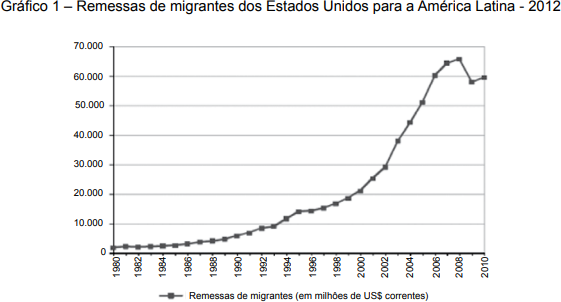
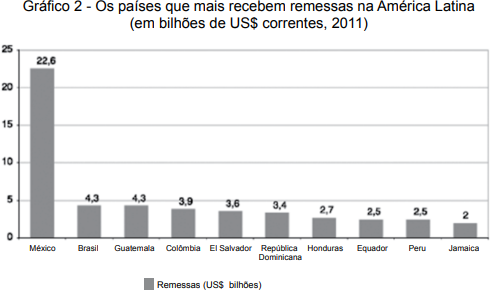
MAGALHÃES, Luís F. A. Remessas e migrações internacionais: elementos teóricos. In: BAENINGER, Rosana (org.). Migrações internacionais. Campinas: Núcleo de Estudo de População – NEPO: Unicamp, 2013. pp 35-63 (gráficos pp 50-56). (Adapt.)
Todos os anos, os Estados Unidos recebem centenas de imigrantes legais e ilegais oriundos de diversos países.
Com base nos dados apresentados e em outros conhecimentos do assunto, é INCORRETO afirmar que
Questão 26 10768567
COLTEC 2023Analise os mapas a seguir, que retratam características da população brasileira:
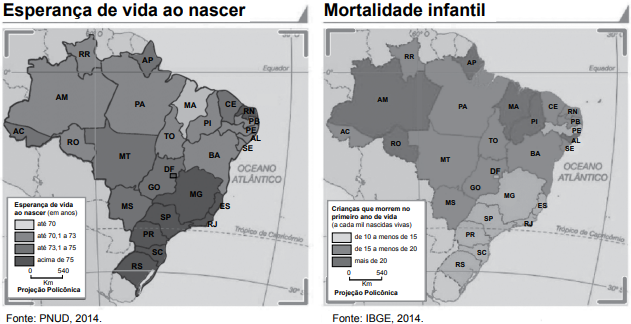
GIRARDI, G. Atlas geográfico do estudante. São Paulo: Editora FTD, 2016. p. 54
Sobre as características da esperança de vida ao nascer e da mortalidade infantil no Brasil, é INCORRETO afirmar que
Questão 25 10768565
COLTEC 2023Leia o fragmento a seguir:
“[...] o manejo do uso humano da natureza, compreendendo a preservação, a manutenção, a utilização sustentável, a restauração e a recuperação do ambiente natural, para que possa produzir o maior benefício, em bases sustentáveis, às atuais gerações, mantendo seu potencial de satisfazer às necessidades e aspirações das gerações futuras, e garantindo a sobrevivência dos seres vivos em geral.”
BRASIL. Lei no 9.985, de 18 de julho de 2000. Disponível em: http://www.planalto.gov.br/ ccivil_03/LEIS/L9985.htm. Acesso em: 8 fev. 2021.
Esse conceito, relacionado à política ambiental brasileira, corresponde à concepção de:
Questão 24 10768564
COLTEC 2023“A anamorfose geográfica é uma forma de representação cartográfica na qual os limites, aqui dados pelas Unidades da Federação, são distorcidos para estabelecer uma relação proporcional entre a área e a quantidade de dados de interesse da geografia.”
LIMA, João Pedro P. C. de. Anamorfose geográfica da COVID-19 no Brasil. Disponível em: https://www.agb.org.br/covid19/2020/08/08/anamorfose-geografica-da-covid-19-no-brasil/. Acesso em: 12 ago. 2021.
Observe a anamorfose a seguir, com os dados relativos aos casos de COVID-19 no Brasil no período entre 25 de fevereiro e 14 de julho de 2020.
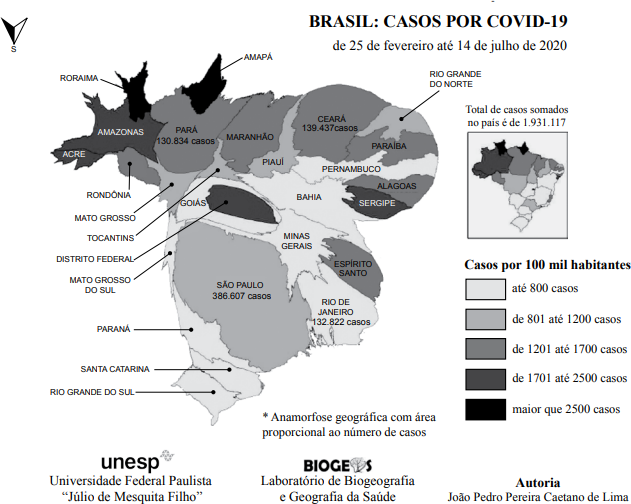
LIMA, João Pedro P. C. de. Anamorfose geográfica da COVID-19 no Brasil. Disponível em: https://www.agb.org.br/covid19/2020/08/08/anamorfose-geografica-da-covid-19-nobrasil/. Acesso em: 12 ago. 2021. (Adapt.)
Com base na análise dessa anamorfose, é CORRETO afirmar:
Questão 50 10765987
CTI (UNIFICADO) C. Gerais 2023Leia o texto.
O período do chamado “milagre” estendeu-se de 1969 a 1973, combinando o extraordinário crescimento econômico com taxas relativamente baixas de inflação.
Os aspectos negativos do “milagre” foram principalmente de natureza social. A política econômica de Delfim Netto, com a criação de um índice prévio de aumento de salários em nível que subestimava a inflação.
Tomando-se como 100 o índice do salário mínimo de janeiro de 1959, ele caíra para 39 em janeiro de 1973. Esse dado é bastante expressivo se levarmos em conta que, em 1972, 52,5% da população economicamente ativa recebia menos de um salário mínimo e 22,8% entre um e dois salários.
(Boris Fausto, História concisa do Brasil. Texto adaptado.)
A política do governo brasileiro sobre o salário mínimo, durante o período do “milagre”,
06