


![[Marketing] Questao Topo - deslogado](https://storage.estuda.com.br/banners/0_6b7ebee90b03af1c560c73bb8bcce34a_banner_deslogado_70_dias.png)
Questões de EFAF Geografia - Hidrografia
152 Questões
Questão 42 10391576
EFOMM 2011Read the text below and answer question
Survivors say Canadian tall ship sank in minutes
Students and crew rescued from the sinking of a Canadia nowned tal ship in the South Atlantic were back on solid and Saturday after spending up to 40 hours in life rafts after their ship capsized.
The first of 64 people on board the three-masted SV Concordia were ferried into Rio de Janeiro aboard Brazilian Navy and merchant vessels, exhausted but relieved after their long ordeal.
Wearing navy caps and borrowed clothing, 12 of those rescued held an emotional news conference in Rio. The rest were to arrive later in the afternoon on two merchant vessels.
CTV producer Ana Pereira said survivors indicated that the ship went down very quickly, slipping beneath the waves. The ship’s captain said that his vessel sank Wednesday afternoona day earlier than previously reported - after being flipped on its side by a powerful gust of wind. He and his passengers and crew were rescued by merchant ships early Friday.
Capt. William Curry told reporters he was below deck when the ship suddenly keeled, banking over at a sharp, angle in the strong wind. Curry said that was normal, but when the vessel immediately went over a second time, he knew the vessel was in great danger.
The captain blamed the wreck on a “microburst”, a sudden, vertical downdraft that struck the entire surf ace area of the Concordia’s sails as it was angled over to one side. Within seconds, the boat went from sailing upright to lying on its side and beginning to sink.
Thirty minutes later it was completely underwater, Curry said.
“The boat started keeling a lot”, said 16-year-old passenger Lauren Unsworth, a Dutch-Canadian who lives in Amsterdam. “It came back up, keeled again, was basically lying on its side and all the windows began to break. That’s when we knew it was time to flee.”
Curry said that they abandoned ship and took to their life rafts in high winds and heavy seas, spending more than a day adrift in the Atlantic before spotting their rescuers.
“We had been in the life raft for about 30 hours when we saw a search plane for the first time”, Unsworth added. “That’s when we knew we were not alone and that help was on the way.” Toronto-native Keaton Farwell said her biggest fear was that no one was aware the group needed to be rescued.
“We thought our signal had failed and nobody knew and it could be weeks before we were saved”, she told a news conference. “The worst life-and-death thoughts were going through our heads, and everybody was panicking.”
The Navy said the distress signal was picked up about 5 p.m. Thursday. An Air Force plane later spotted life rafts in the ocean about 500 kilometers from Rio and a Navy ship and nearby merchant vessels moved in to aid in the rescue.
The first 12 crew and students came into port aboard a Brazilian Navy frigate. The rest were heading into Rio aboard slower merchant vessels and were expected to arrive later Saturday afternoon.
The Concordia was five days out from Montevideo, Uruguay, when it sank.
The Federal Transportations Safety Board says it will assist in an investigation to be led by the ship’s flag state country, Barbados.
The Concordia is owned by West Island College International with offices in Lunenburg, N.S. Forty-two of those onboard were identified as Canadians, mostly high school and university students, said Kate Knight, head of West Island College International of Lunenburg, which operates the Class Afloat program. Prime Minister Stephen Harper issued a statement thanking the Brazilian Navy and the merchant ships “for their swift and heroic response.”
(Adapted from: www.ctv.ca, www.ap.com, Feb. 2010)
A news conference was held in Rio de Janeiro with some of the survivors. It is correct to affirm that:
(A) Not all survivors were able to attend the conference because some were still on life rafts waiting for merchant vessels to rescue them. Besides, other survivors were returning to Canada as soon as possible.
(B) Some survivors were too emotional to participate because of all the stress they suffered during the accident and the only thing they wanted to do was to see their / families as soon as possible.
(C) Survivors gradually arrived in Rio de Janeiro due to different rescue procedures and some were still aboard merchant ships on their way to the coast of Brazil while the interview was held.
(D) A few survivors were not able to participate because they had lost all of their personal belongings in the tragedy and did not have clothes to appear in public, though donations were received.
(E) A number of survivors was brought to Rio de Janeiro by helicopter and therefore arrived faster than the ones who carne on slower merchant vessels. Also, there were some survivors who had already returned to Canada.
Comentário: Uma conferência de imprensa foi realizada no Rio de Janeiro com alguns dos sobreviventes. É correto afirmar que:
Questão 41 10391510
EFOMM 2011Read the text below and answer question
Survivors say Canadian tall ship sank in minutes
Students and crew rescued from the sinking of a Canadia nowned tal ship in the South Atlantic were back on solid and Saturday after spending up to 40 hours in life rafts after their ship capsized.
The first of 64 people on board the three-masted SV Concordia were ferried into Rio de Janeiro aboard Brazilian Navy and merchant vessels, exhausted but relieved after their long ordeal.
Wearing navy caps and borrowed clothing, 12 of those rescued held an emotional news conference in Rio. The rest were to arrive later in the afternoon on two merchant vessels.
CTV producer Ana Pereira said survivors indicated that the ship went down very quickly, slipping beneath the waves. The ship’s captain said that his vessel sank Wednesday afternoona day earlier than previously reported - after being flipped on its side by a powerful gust of wind. He and his passengers and crew were rescued by merchant ships early Friday.
Capt. William Curry told reporters he was below deck when the ship suddenly keeled, banking over at a sharp, angle in the strong wind. Curry said that was normal, but when the vessel immediately went over a second time, he knew the vessel was in great danger.
The captain blamed the wreck on a “microburst”, a sudden, vertical downdraft that struck the entire surf ace area of the Concordia’s sails as it was angled over to one side. Within seconds, the boat went from sailing upright to lying on its side and beginning to sink.
Thirty minutes later it was completely underwater, Curry said.
“The boat started keeling a lot”, said 16-year-old passenger Lauren Unsworth, a Dutch-Canadian who lives in Amsterdam. “It came back up, keeled again, was basically lying on its side and all the windows began to break. That’s when we knew it was time to flee.”
Curry said that they abandoned ship and took to their life rafts in high winds and heavy seas, spending more than a day adrift in the Atlantic before spotting their rescuers.
“We had been in the life raft for about 30 hours when we saw a search plane for the first time”, Unsworth added. “That’s when we knew we were not alone and that help was on the way.” Toronto-native Keaton Farwell said her biggest fear was that no one was aware the group needed to be rescued.
“We thought our signal had failed and nobody knew and it could be weeks before we were saved”, she told a news conference. “The worst life-and-death thoughts were going through our heads, and everybody was panicking.”
The Navy said the distress signal was picked up about 5 p.m. Thursday. An Air Force plane later spotted life rafts in the ocean about 500 kilometers from Rio and a Navy ship and nearby merchant vessels moved in to aid in the rescue.
The first 12 crew and students came into port aboard a Brazilian Navy frigate. The rest were heading into Rio aboard slower merchant vessels and were expected to arrive later Saturday afternoon.
The Concordia was five days out from Montevideo, Uruguay, when it sank.
The Federal Transportations Safety Board says it will assist in an investigation to be led by the ship’s flag state country, Barbados.
The Concordia is owned by West Island College International with offices in Lunenburg, N.S. Forty-two of those onboard were identified as Canadians, mostly high school and university students, said Kate Knight, head of West Island College International of Lunenburg, which operates the Class Afloat program. Prime Minister Stephen Harper issued a statement thanking the Brazilian Navy and the merchant ships “for their swift and heroic response.”
(Adapted from: www.ctv.ca, www.ap.com, Feb. 2010)
The Concordia very likely started to sink due to:
(A) The inability of the captain to avoid a dangerous tropical storm with high waves off the coast of Brazil which capsized the ship within minutes.
(B) Powerful winds that surprised everyone aboard and eventually capsized the vessel, though it remained for a few minutes lying on its side.
(C) High waves that are common in that part of the ocean and, according to the captain, flipped the ship to its side before it immediately sank.
(D) The excess of weight aboard the ship which, during a storm with strong vertical winds, contributed to flipping the ship on its side before it sank.
(E) Events that are still under investigation for Brazilian Navy Officers have not had access to the remains of the shipwreck because of the weather conditions. Comentário:
Muito provavelmente o Concordia começou a fundar devido à:
Questão 47 11230301
IFSP 2010/1Considere o gráfico e a tabela a seguir.
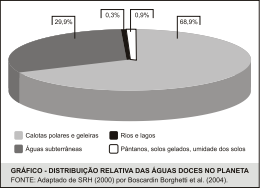
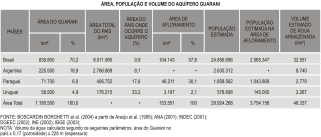
Analise as considerações a seguir.
I. Do total de água que recobre a superfície da Terra, 97,5% constitui-se de água doce e apenas 2,5% em água salgada.
II. Do total do volume de água salgada do planeta, cerca de 30,2% pode ser utilizada para a vida vegetal e animal nas terras emersas, pois 69,8% encontram-se nas calotas polares, geleiras e solos gelados. Cerca de 98,7% da água salgada corresponde à parcela de água subterrânea, e apenas 0,9% corresponde ao volume de água salgada superficial (rios e lagos), diretamente disponível para as demandas humanas, que corresponde a 0, 008% do total de água no mundo.
III. Do total da área do aquífero, 12,8% estão representados pelas zonas de afloramento, sendo que 67,8% localizam-se no Brasil; 30,1%, no Paraguai e 2,1%, no Uruguai. Até o presente momento não foram identificadas áreas de afloramento na Argentina.
IV. A área do Guarani, na Argentina, é de 225.500 km2; no Paraguai é de 71.700 km2; no Uruguai é de 58.500 km2 , e no Brasil é de 840 mil km2 (ARAÚJO et al., 1995), espalhando-se pelo subsolo de oito estados (Mato Grosso, Mato Grosso do Sul, Goiás, Minas Gerais, São Paulo, Paraná, Santa Catarina e Rio Grande do Sul) num total de 70,2% da área total do aquífero.
Quantas considerações estão corretas?
Questão 25 10177507
IFCE* 1° Ano 2010/1Sobre as características da hidrografia brasileira, são feitas as seguintes afirmações.
I. Considerando-se os rios de maior porte, só é encontrado regime temporário no sertão nordestino, onde o clima é semiárido, no restante do país, os grandes rios são perenes.
II. Predominam os rios de planalto em áreas de elevado índice pluviométrico. A existência de muitos desníveis no relevo e o grande volume de água possibilitam a produção de hidroeletricidade.
III. Na região Amazônica, os rios têm grande importância como vias de transporte, e o potencial hidrelétrico é amplamente aproveitado.
Está correto o que se afirma em
Questão 52 10174929
IFSertãoPE 2010Considere a figura a seguir.
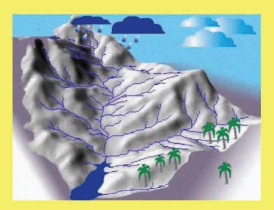
Fonte: http://www.eco.unicamp.br/nea/Gestao_ /. Acesso em 24 de novembro de 2009.
A figura representa
Questão 47 10174879
IFSertãoPE 2010Considere o gráfico e a tabela a seguir.
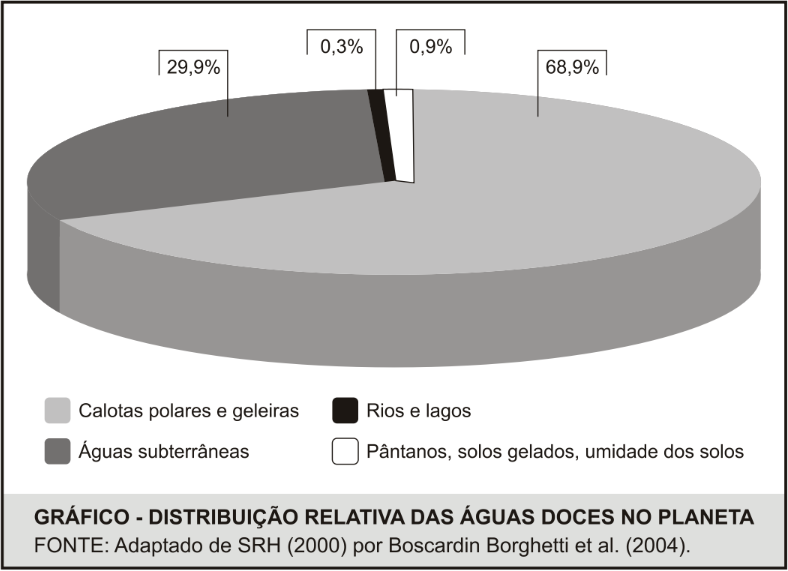
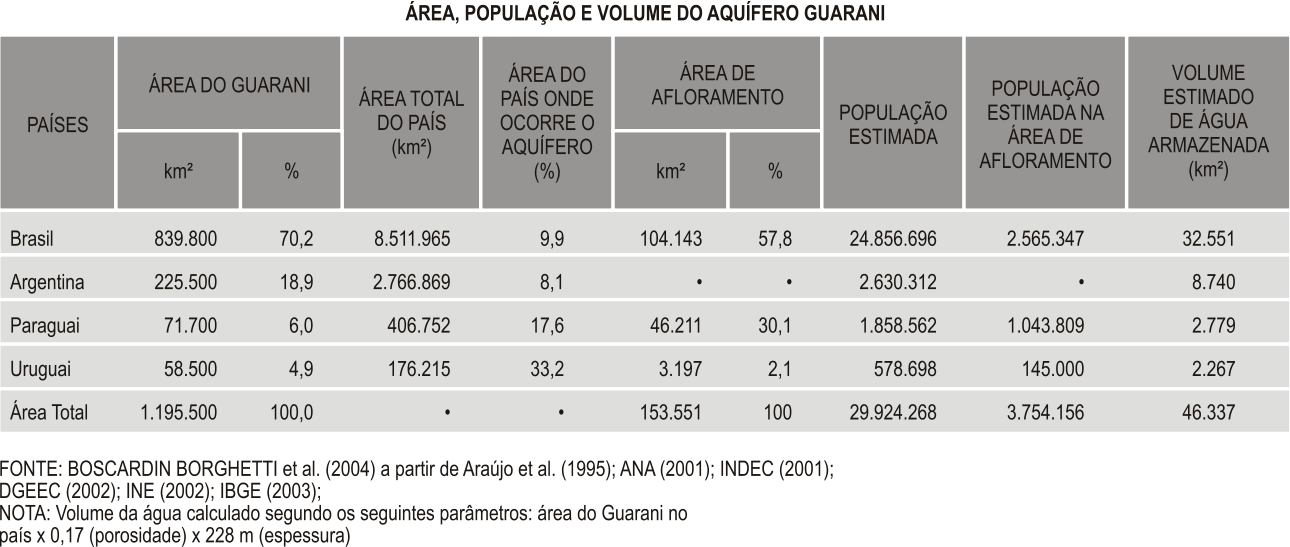
Analise as considerações a seguir.
I. Do total de água que recobre a superfície da Terra, 97,5% constitui-se de água doce e apenas 2,5% em água salgada.
II. Do total do volume de água salgada do planeta, cerca de 30,2% pode ser utilizada para a vida vegetal e animal nas terras emersas, pois 69,8% encontram-se nas calotas polares, geleiras e solos gelados. Cerca de 98,7% da água salgada corresponde à parcela de água subterrânea, e apenas 0,9% corresponde ao volume de água salgada superficial (rios e lagos), diretamente disponível para as demandas humanas, que corresponde a 0, 008% do total de água no mundo.
III. Do total da área do aquífero, 12,8% estão representados pelas zonas de afloramento, sendo que 67,8% localizam-se no Brasil; 30,1%, no Paraguai e 2,1%, no Uruguai. Até o presente momento não foram identificadas áreas de afloramento na Argentina.
IV. A área do Guarani, na Argentina, é de 225.500km2; no Paraguai é de 71.700 km2; no Uruguai é de 58.500 km2 , e no Brasil é de 840 mil km2 (ARAÚJO et al., 1995), espalhando-se pelo subsolo de oito estados (Mato Grosso, Mato Grosso do Sul, Goiás, Minas Gerais, São Paulo, Paraná, Santa Catarina e Rio Grande do Sul) num total de 70,2% da área total do aquífero.
Quantas considerações estão corretas?
06